
Year-End Closed-End Fund Distributions: Why Your Statement May Look Lighter Than Reality
 by Jon Sobotkin|November 6th, 2026
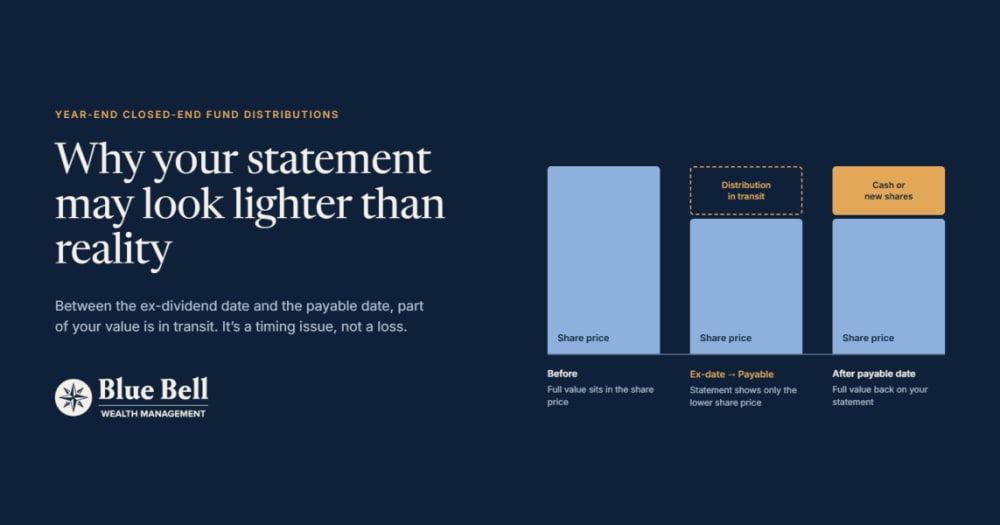
Year-End Closed-End Fund Distributions: Why Your Statement May Look Lighter Than Reality
Starting in November, many Closed-End Funds (CEFs) pay out their annual capital gains and income distributions. It's a routine part of how these funds operate, but the timing of those payments creates a quirk that can catch clients off guard: for a stretch of a few weeks, your statement may show a portfolio value that looks lower than it should. Let me walk you through what's happening behind the scenes.
Two Dates That Matter
Every distribution has two key dates, and the gap between them is where the confusion lives.
The ex-dividend date is the date on which the fund's share price trades without the value of the upcoming distribution. If you buy shares on or after the ex-dividend date, you will not receive that distribution. When a fund goes ex-dividend, its market price drops by roughly the amount of the distribution on that day, because the distribution is no longer "attached" to the shares. The fund's Net Asset Value (NAV) drops by the same amount as well. Nothing has been lost. The value has simply moved from the share price into a distribution that is now owed to you.
The payable date (also called the payment date) is when the fund actually sends the cash or reinvests it in additional shares. This can be several weeks after the ex-dividend date, and during that window the distribution exists as a receivable, money owed to you that hasn't landed yet.
A Real Example
Here's how this plays out with an actual year-end distribution. General American Investors (NYSE: GAM) declared an annual distribution of $7.43 per share, with an ex-dividend date of November 16, 2026, and a payable date of December 30, 2026.
On November 16, GAM's share price and NAV will be adjusted down $7.43 per share to account for the distribution that is now owed to shareholders. But the cash won't arrive until December 30. That means for roughly six weeks, anyone holding GAM will see the position valued at its lower post-ex-dividend price on their statement, with the $7.43 per share distribution still in transit. A statement dated anywhere in that window will understate the account's true value by the amount of the pending distribution.
What You'll See on Your Statement
Here's the part that trips people up. Once a fund goes ex-dividend, its share price (and NAV) have already dropped to reflect the distribution. But the cash or reinvested shares don't hit your account until the payable date. In the meantime, the statement value of that position is based on the lower post-ex-dividend price and the distribution itself may not appear anywhere as a line item.
The result: your statement shows the position at its reduced value without yet showing the distribution that caused the reduction. The account looks like it lost money when, in reality, the value has been split between the shares and the distribution owed to you.
The Bottom Line
Until the payable date arrives and the distribution is paid or reinvested, your statement will understate the true value of the account. This is a timing issue, not a loss. Once the payable date passes, whether the distribution arrives as cash or as additional shares through reinvestment, the picture comes back into focus and the account value reflects everything you own.
As always, if you have questions about how a specific distribution affects your portfolio, reach out and we'll walk through it together.