
Software Stocks Are Getting Hit Hard. Here's Why We Don't Try to Ride It Unhedged.
A plain-English look at the recent volatility in tech and software — and how our hedged equity approach is built for exactly this kind of market.
 by Justin Capetola|August 4th, 2026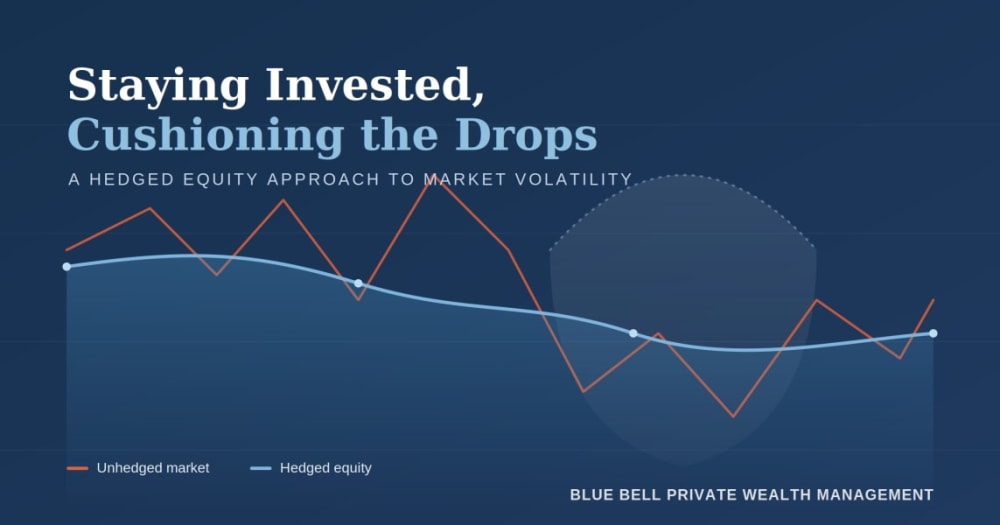
If you've glanced at your portfolio or the financial headlines over the past few weeks, you've probably noticed the market has gotten choppy — especially in technology. Some days the major indexes hit fresh highs; other days they sell off sharply. Underneath that back-and-forth, one part of the market has been under real, sustained pressure: software.
What's happening in software
For most of the last two decades, software companies were among the most reliable growth stories on Wall Street. Their subscription model — customers paying per user, per month, year after year — was considered almost bulletproof. High switching costs and "sticky" contracts kept revenue predictable, and investors paid premium prices for that reliability.
That assumption is now being challenged. The rapid rise of AI "agents" — tools that can carry out multi-step business tasks like drafting documents, building spreadsheets, and automating workflows — has investors questioning whether companies will keep paying for as many traditional software seats. The concern intensified in late July when a major new enterprise-AI product launch sent a fresh wave of selling through software names. Commentators have taken to calling the broader repricing the "SaaSpocalypse."
The numbers tell the story. The most widely watched software index is down roughly 20% or more so far in 2026, even as the overall market has held near record territory. Well-known names have fallen 30% or more from where they started the year. In one striking sign of how sentiment has shifted, software valuations recently dropped below the valuation of the broad market for the first time in memory — a reversal from years of trading at a hefty premium.
Not everyone thinks the fear is justified. Analysts at several major banks have argued the selloff has gone too far, pointing out that long-term contracts and high switching costs still protect many of these businesses, and that markets may be pricing in a worst-case scenario that never fully arrives. In other words: there is real disruption underway, but also real disagreement about how much of it is already reflected in prices. That disagreement is precisely what creates volatility.
The bigger picture: a market pulling in different directions
Software isn't moving in isolation. A few other themes have shaped recent weeks:
Big AI spenders are being scrutinized. Several of the largest technology companies are pouring enormous sums into AI infrastructure and data centers. Investors have started asking a pointed question — when does all that spending actually pay off? — and have punished some of the biggest names for heavy capital budgets and thin free cash flow.
Money is rotating into more traditional sectors. As enthusiasm for parts of tech has cooled, health care and financial stocks have pushed to new highs, as some investors shift toward areas of the market seen as steadier.
Milestones and mixed signals. One mega-cap technology company briefly became the first to reach a $5 trillion market value, while long-term interest rates climbed to their highest levels in years and second-quarter economic growth came in soft. It's a market sending several conflicting messages at once.
Why this kind of market is exactly what we plan for
Here's the honest truth about episodes like this: nobody can reliably predict which day the market swings up and which day it swings down, or whether the software selloff is nearly over or only halfway through. Anyone who tells you otherwise is guessing.
That uncertainty is the whole reason we take a different approach. At Blue Bell PWM we use a hedged equity strategy designed to keep our clients invested in the growth potential of the market while deliberately softening the impact of sharp declines.
The idea is straightforward. Traditional investing asks you to accept the market's full ride — the highs and the gut-wrenching lows — in exchange for long-term growth. A hedged equity approach keeps you participating in that growth, but uses protective positioning to cushion some of the downside when volatility spikes. You give up a slice of the very best-case upside in return for a smoother path and less exposure to severe drawdowns.
For the high-net-worth families and pre-retirees we serve across Blue Bell and Montgomery County, that trade-off often makes sense. When you've already built substantial wealth, protecting it can matter as much as growing it. A 30% drop in a concentrated software position is a very different experience for someone five years from retirement than it is for someone with decades to recover — and it's exactly the kind of concentration risk a thoughtful, hedged portfolio is designed to manage.
What you should actually do right now
For most of our clients, the answer during weeks like these is reassuring: not much. If your portfolio is properly diversified, appropriately hedged, and aligned with your goals and timeline, short-term turbulence in software or AI stocks is noise — not a reason to react.
But this is also a good moment to ask a few honest questions. Do you know how concentrated your portfolio is in technology? Are you taking more risk than you realize because a handful of winners has grown to dominate your holdings? Is your plan built to weather a genuine downturn, not just to enjoy a bull market? If you're not sure, that's worth a conversation.